

Thirteen years. Nearly 355,000 people. One unusually quiet signal: people who drank coffee had lower observed risks of cirrhosis, liver cancer, and liver-related mortality than people who didn’t drink coffee.
In the 2026 study of 354,957 UK Biobank participants, those drinking five or more cups per day had associations with a 32% lower risk of cirrhosis, a 47% lower risk of hepatocellular carcinoma, and a 42% lower risk of liver-disease mortality compared with non-drinkers. The strongest pattern appeared around three to four cups per day, and the association also appeared with decaf.
That last detail matters. Caffeine may be part of coffee’s story, but it probably isn’t the entire story.
Now for the question that usually follows: “What about mold?” The honest answer is more measured than the internet version. Ochratoxin A is a real mycotoxin, and contaminated raw materials deserve serious food-safety controls. But roasting substantially reduces OTA in many studies, brewing changes what reaches the cup, European regulators set maximum levels, and ordinary trace exposure from compliant coffee hasn’t been shown to damage liver health.
Don’t panic. Don’t accept a marketing slogan as a lab report. Control the variables you can control: source, roast, brew, storage, and consistency.
That’s the Ready Standard.
Key Takeaways
- A 2026 Clinical Gastroenterology and Hepatology study followed 354,957 UK Biobank participants for a median of 13 years.
- Compared with non-drinkers, people consuming five or more cups daily showed lower observed risks of cirrhosis, liver cancer, and liver-related mortality.
- The association began at one to two cups, appeared strongest around three to four cups, and was also seen with decaffeinated coffee.
- Ochratoxin A is a legitimate food-safety concern at high exposure, but roasting and brewing can substantially reduce the amount present in the finished drink.
- A lab result means only what its sample, method, analyte, lot, and collection date support. Use standards: not fear: to evaluate coffee.
What 355,000 People Showed Us
The study comes from a Cedars-Sinai-associated research team led by H.S. Kim and was published in 2026 in Clinical Gastroenterology and Hepatology. The researchers analyzed UK Biobank data from 354,957 adults who did not have cirrhosis or hepatocellular carcinoma at the start of the study.
The median follow-up was 13 years.
That’s long enough to observe meaningful differences in outcomes. It’s also a large enough population to make the findings more useful than a small short-term experiment. Still, the design matters. This was an observational cohort study, not a randomized trial in which researchers assigned people to drink specific amounts of coffee.
The researchers looked at:
- Coffee consumption and number of cups per day
- Caffeinated versus decaffeinated coffee
- Sugar and artificial sweetener use
- New diagnoses of cirrhosis
- Hepatocellular carcinoma, the most common primary liver cancer
- Liver-related mortality
- MRI measurements of liver fat, iron, and fibroinflammation
- Blood-based proteomic patterns
The primary outcome numbers were striking.
Compared with non-drinkers, the group consuming five or more cups per day had:
- 32% lower observed risk of cirrhosis
- 47% lower observed risk of hepatocellular carcinoma
- 42% lower observed risk of liver-related mortality
In statistical terms, the reported hazard ratios for the five-plus-cup group were approximately 0.68 for cirrhosis, 0.53 for hepatocellular carcinoma, and 0.58 for liver-related mortality.
A hazard ratio below 1.0 indicates a lower observed rate of the outcome in that group over the study period. It does not mean that every individual coffee drinker receives the same reduction. It does not predict what will happen to a specific person. It does not mean that coffee prevents all liver disease.
The dose pattern was also important.
The association began at approximately one to two cups per day and appeared strongest around three to four cups per day. The five-plus group still had favorable associations, but the study should not be read as a command to keep adding cups. More isn’t automatically better. Dose, preparation, sleep, medications, pregnancy, blood pressure, anxiety, and individual tolerance still matter.
Think of the dose-response pattern as a signal: not a marching order.
The decaf finding changes the conversation
The study found similar favorable associations for caffeinated and decaffeinated coffee.
That doesn’t prove caffeine is irrelevant. Caffeine has well-studied effects on alertness, blood flow, metabolism, and the nervous system. But if decaf shows a similar pattern, then caffeine alone probably can’t explain the entire association.
Coffee is not just caffeine in a cup. It’s a complex food made up of hundreds of compounds shaped by species, origin, processing, roast profile, grind, water, and extraction.
The study also reported associations regardless of whether participants added sugar or artificial sweeteners, although additive use showed some differences in imaging-related measures. That result should not be turned into a permission slip for unlimited sweetened coffee. It simply means the headline association wasn’t limited to people drinking coffee black.
A sweetened coffee beverage can have a very different nutritional profile from a plain brewed coffee. Keep those categories separate.
Imaging and proteomics gave the study more depth
The study didn’t rely only on self-reported diagnoses.
In a subcohort of 28,961 people who underwent MRI, higher coffee intake was associated with lower measures of hepatic fat, iron, and fibroinflammation. In another group of 44,633 participants, researchers analyzed blood proteins using Olink proteomic assays.
Those additional layers matter because liver disease can develop quietly. A person may feel normal while metabolic changes, fat accumulation, inflammation, or fibrosis are already progressing.
The MRI and proteomic findings don’t prove coffee caused the favorable patterns. They do provide biological context that supports the plausibility of the clinical findings.
The cleanest summary is this:
Coffee consumption was associated with more favorable clinical, imaging, and proteomic indicators of liver health across a large prospective population.
That is a strong research signal. It is not a treatment recommendation.
Why Your Liver Cares About Coffee
The liver is a processing plant, filtration system, storage depot, metabolic control center, and repair operation. It handles nutrients, medications, alcohol, hormones, and countless compounds that enter the body.
Coffee brings a complicated chemical profile to that operation.
Researchers have proposed several possible pathways through which coffee may be associated with liver health:
- Chlorogenic acids and other polyphenols may influence oxidative stress and glucose metabolism.
- Coffee compounds may affect inflammatory signaling.
- Caffeine may influence metabolic and vascular pathways.
- Coffee may interact with bile production and liver enzyme activity.
- Non-caffeine compounds may influence fibrosis-related processes.
- Coffee may be associated with lower liver fat in some populations.
These are plausible mechanisms, not settled explanations.
Coffee chemistry also changes during roasting. Green beans contain one profile of compounds. Roasted beans contain another. Roast degree influences acidity, bitterness, aroma, body, volatile compounds, and the balance of compounds extracted into water.
That’s why “coffee” isn’t a single uniform exposure. A small espresso, a large filtered mug, an instant coffee, a cold brew concentrate, and a sweetened blended drink may all carry different amounts of caffeine and different chemical profiles.
The 2026 UK Biobank findings are useful precisely because they looked beyond caffeine. The decaf result suggests that the liver-related association may involve the broader coffee matrix rather than one isolated ingredient.
But stay disciplined with the conclusion. Researchers observed a pattern among coffee drinkers. They did not prove that one particular roast, origin, blend, or brand prevents disease.
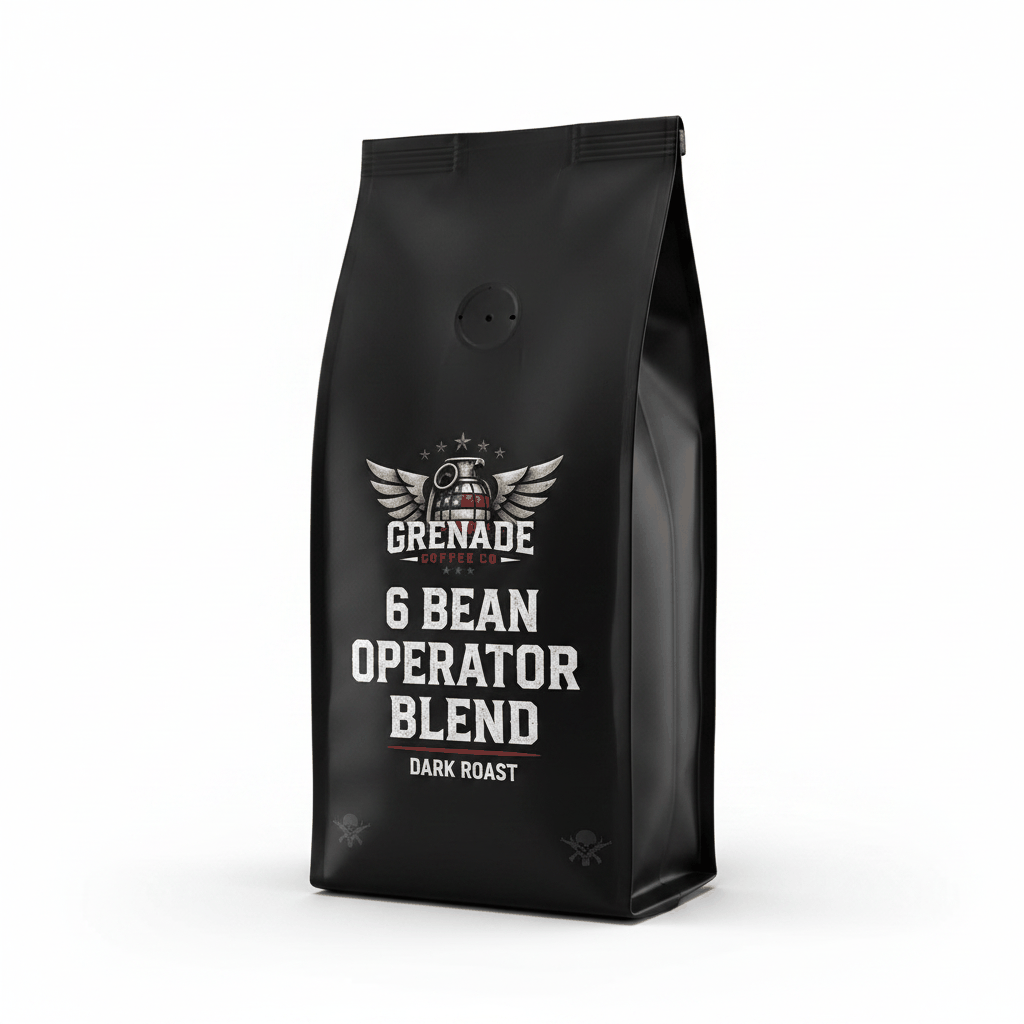
The 6 Bean Operator Blend is a dark roast made from six 100% Arabica origins. Grenade Coffee describes it as having dark-chocolate notes, smoky depth, low acidity, and a full body. It is roasted to order and available whole bean or ground for different brew methods. Those are product facts: not evidence that the blend produces the liver outcomes reported in the study.
The study was about coffee consumption patterns. It was not a clinical trial of Grenade Coffee.
The Mold Question, Answered Without the Fear
Let’s address the objection directly.
Coffee is an agricultural product. Agricultural products can be exposed to environmental molds during cultivation, harvesting, drying, storage, and transport. Some molds can produce mycotoxins.
One mycotoxin that appears in coffee research is ochratoxin A, commonly abbreviated OTA.
OTA is real. It isn’t an invented concern. At high exposure levels, research has associated it with kidney toxicity and potential liver toxicity in experimental settings. The International Agency for Research on Cancer has classified OTA as possibly carcinogenic to humans, which is one reason food-safety authorities monitor it.
But “OTA exists” and “your coffee is harming your liver” are not the same statement.
The exposure question depends on:
- How much OTA was present in the raw material
- Whether the test measured green beans, roasted beans, ground coffee, or brewed coffee
- How the sample was selected
- What analytical method was used
- How much coffee was consumed
- How much OTA transferred into the finished drink
- Whether the reported result came from one lot or represents a larger supply
Roasting changes the equation
Several studies have examined what happens to OTA during roasting.
Results vary by contamination level, roast temperature, time, roast method, and sample. But the research commonly reports substantial reductions. Across studies, reported reductions are often in the approximate range of 69% to 96%, with some experiments reporting broader results.
A PubMed-indexed study found that roasting produced a 65% to 100% reduction in OTA under the tested conditions. Other studies found reductions around 70% to 95%, particularly under more developed roast conditions.
That doesn’t mean roasting magically makes every batch identical. It means the amount detected in green coffee is not automatically the amount present in roasted coffee.
Roasting can also transform OTA into other compounds, including thermal degradation products and the isomer 2′R-OTA. Research on those compounds is still developing. That’s another reason responsible communication matters: don’t replace one oversimplification with another.
The correct statement is not “roasting destroys everything.”
The correct statement is:
Roasting can substantially reduce OTA, but the extent depends on the raw material and the roasting conditions, and the chemistry of thermal transformation deserves continued study.
Brewing changes what reaches the cup
Brewing is another control point.
One study that tracked coffee from green beans through roasting and brewing reported that espresso preparation produced approximately a 49.8% reduction in OTA concentration relative to the roasted coffee used. Auto-drip brewing showed approximately a 14.5% reduction, while moka brewing showed approximately a 32.1% reduction in that study.
Another study reported stronger reductions for moka preparation under its tested conditions.
These figures should not be treated as universal performance guarantees. Brewing variables change constantly:
- Coffee dose
- Grind size
- Water temperature
- Contact time
- Pressure
- Filtration
- Ratio of water to coffee
- Bean chemistry
- Roast profile
Longer immersion can extract more compounds. Pressure and shorter contact time can change transfer. Paper filters may retain some coffee oils and solids. None of these variables turns a home brewer into a certified contaminant-testing laboratory.
Brewing is a quality control point: not a guarantee.
The regulatory picture matters
The European Union sets maximum OTA levels for certain foods under Commission Regulation (EU) 2023/915, as amended.
The current consolidated regulation lists:
- 3 micrograms per kilogram for roasted coffee beans and ground roasted coffee
- 5 micrograms per kilogram for soluble coffee
Older articles may cite higher limits, including 5 micrograms per kilogram for roasted coffee and 10 micrograms per kilogram for soluble coffee. Those figures reflect earlier rules or older summaries. Use the current regulation when discussing current EU maximum levels.
Regulatory limits are not a claim that every product contains the maximum amount. They are legal maximums used to control contamination in food placed on the market.
The European Food Safety Authority has also changed how it evaluates OTA risk. Earlier assessments used a tolerable weekly intake of 120 nanograms per kilogram of body weight per week. In its 2020 re-evaluation, EFSA concluded that the previous health-based guidance value should no longer be maintained because of OTA’s potential genotoxic and carcinogenic properties. EFSA now uses a margin-of-exposure approach and emphasizes keeping exposure as low as reasonably achievable.
That distinction matters.
Don’t cite an old TWI as if it were current law. Don’t claim “zero risk.” Don’t imply that an ordinary cup of compliant coffee has been shown to harm liver health.
Based on the evidence reviewed for this article, ordinary trace exposure from compliant roasted coffee has not been established as a cause of liver damage. At the same time, a responsible roaster shouldn’t claim that every bean from every source is identical or that one test proves permanent purity.
What Fear Marketing Claims: and What the Evidence Supports
| Fear-marketing claim | What the evidence actually supports | What the operator should do |
|---|---|---|
| “Coffee is full of toxic mold.” | Coffee is an agricultural product, and OTA can occur in some samples. The phrase “full of” says nothing about concentration, lot, method, or finished-cup exposure. | Ask what was tested, how it was tested, and whether the result applies to the product in question. |
| “Any detection means the coffee is dangerous.” | Detection alone does not establish dose, risk, or clinical harm. The analyte, level, method, and exposure context matter. | Look at the number, units, limit of quantification, sample identity, and applicable standard. |
| “Roasting eliminates every concern.” | Roasting can substantially reduce OTA, but results vary, and thermal transformation chemistry remains an active research area. | Treat roast as one control point, not a magic shield. |
| “A single lab result proves a brand is contaminated.” | A single result describes a sample from a particular lot at a particular time using a particular method. | Demand lot-specific context before generalizing. |
| “Mold-free” means scientifically proven safe. | “Mold-free” and “toxin-free” are broad marketing phrases unless narrowly defined and supported by validated testing. | Prefer transparent sourcing, food-safety controls, and restrained claims. |
| “Coffee causes liver disease because OTA exists.” | Current evidence does not establish that trace OTA exposure from ordinary compliant coffee causes liver disease. | Keep the OTA question separate from the observational coffee-and-liver findings. |
| “Coffee prevents liver disease.” | Observational studies show associations, not proof that coffee prevents disease or treats existing disease. | Enjoy coffee as part of a broader routine, but don’t use it as treatment. |
The Quiet Liver Protocol: Control What You Can Control
The liver study answers one question: what pattern did researchers observe in a large population?
The OTA question answers another: what controls influence food quality between farm and cup?
Keep those questions separate. Then build a practical protocol around the points you can actually manage.
Source
Start with the supply chain.
Coffee origin matters for flavor, agricultural conditions, processing, and traceability. Single-origin coffee can tell you where a coffee comes from, but the phrase alone doesn’t guarantee a particular contaminant result or quality level.
Grenade Coffee describes its sourcing network as including more than 66 farms across 17 countries. Its single-origin collection includes coffees from regions across Central America, South America, Africa, and Southeast Asia.
That transparency doesn’t mean the brand can make a universal medical claim. It means origin is treated as part of the coffee’s identity rather than erased behind generic commodity labeling.
Ask practical questions:
- Is the origin identified?
- Is the product roasted and packed in the United States?
- Is there a roast or shipment process?
- Can the operator explain its sourcing and quality-control approach?
- Is the product sitting for months in an anonymous warehouse?
Roast and facility
The second control point is the roast.
Grenade Coffee emphasizes roasting in an FDA-inspected facility, small-batch production, and shipping coffee generally roasted within days of shipment. The product page describes the 6 Bean Operator Blend as roasted to order and not warehoused as finished coffee for long periods.
Again, separate the claims.
Freshness is not the same as contaminant testing. An FDA-inspected facility is not a guarantee that every possible analyte is absent. Roast-to-order is not a medical intervention. But controlled production, sanitation, traceability, and a disciplined roast process are more meaningful than dramatic packaging language with no operating details behind it.
The operator standard is simple:
Prefer a supply chain that can explain what happens to the coffee before it reaches your counter.
Brew
Now pull the pin.
Brew before distractions. Use a consistent ratio. Keep your equipment clean. Use water that tastes good and is appropriate for brewing. Don’t let a complicated gadget become an excuse to skip the ritual.
Grenade Coffee’s 6 Bean Operator Blend is listed as suitable for French press, drip, pour-over, and AeroPress. Use the method that fits the mission.
For a repeatable brew:
- Measure the coffee rather than guessing.
- Keep grind size consistent.
- Use a stable water temperature.
- Record what tastes good.
- Clean the brewer and grinder regularly.
- Avoid leaving wet grounds and residue in equipment.
- Don’t assume the most expensive machine produces the most controlled cup.
The point is not to turn breakfast into a laboratory. The point is to stop treating every variable as random.
Store
The final control point is the counter.
Store coffee in a cool, dry place in an airtight container. Protect it from heat, light, and moisture. Don’t keep the bag open beside a steaming kettle or in a humid cabinet.
Grenade Coffee recommends using opened coffee within approximately three weeks and storing it in a cool, dry place. Follow the specific storage instructions for the product you purchase.
Storage affects flavor, aroma, oxidation, and the overall quality of the cup. It also prevents you from blaming the roaster for a bag that has been left open in a damp environment for months.
The brand doesn’t claim its coffee is “mold-free” or “toxin-free.” That restraint is intentional. The standard is not fear reduction through a louder slogan. It’s better control through sourcing, roasting, preparation, and storage.

Pull. Pour. Proceed.
The Quiet Liver Protocol fits the Grenade Coffee ritual:
Pull
Pull the pin on average before the day starts pulling you in six directions.
Choose the coffee. Check the roast. Keep the supply consistent. Brew before email, headlines, notifications, and noise.
This is the trigger-action portion of the ritual: alarm, sunrise, kettle, grinder, brew.
Pour
Pour the cup and drink it in the format that works for you.
Black. With milk. Over ice. Decaf when the mission requires a quieter caffeine profile. The goal isn’t to perform a personality test for strangers. The goal is to establish a reliable first action.
Respect the coffee enough to taste it. Respect your body enough to notice how it responds.
Proceed
Write down the one mission that makes today a win.
That’s the investment. The cup starts the operating system, but the action gives it a destination.
A subscription can support that continuity. Grenade Coffee’s product page lists a monthly supply option for the 6 Bean Operator Blend, with repeat delivery, a subscription discount, and the ability to skip or cancel according to the listed terms.
Locked-in supply doesn’t create a health benefit. It creates fewer last-minute substitutions. The bag on the counter is more likely to be the roast you chose rather than an old emergency purchase from a random shelf.
Mission continuity is a logistics benefit.
Hypothetical only
Consider two coffee drinkers over 15 years.
The first drinks approximately three to four cups on most workdays. The coffee comes from a traceable supply chain, is roasted in a controlled facility, is brewed with a consistent method, and is stored in a cool, dry place. The person also sleeps adequately, limits alcohol, exercises, attends routine medical appointments, and follows clinician guidance.
The second drinks heavily and inconsistently. The coffee may sit open for months. The brewer is rarely cleaned. The person assumes strong coffee can compensate for poor sleep and uses the cup as a substitute for medical care.
What does the science suggest?
The 2026 study suggests that moderate coffee consumption can be associated with more favorable liver outcomes at a population level. The study does not tell us that the first person will avoid cirrhosis, liver cancer, or liver-related mortality. It also does not establish that the second person will develop disease because of coffee quality.
The meaningful difference in this hypothetical is not a guaranteed liver result. It is the difference between a controlled routine and an unmanaged one.
The first drinker controls more variables. The second treats coffee as an unexamined input and expects it to fix unrelated problems.
That’s the lesson.
Build a better system. Don’t promise yourself an outcome the research never promised.
Who Should Still Check With a Clinician?
Coffee is a food and beverage. It is not a treatment for cirrhosis, hepatitis, fatty liver disease, fibrosis, liver cancer, or any other medical condition.
Speak with a qualified clinician before changing your coffee intake if you:
- Have diagnosed liver disease or abnormal liver tests
- Have hepatitis or a history of liver injury
- Take medications that may interact with caffeine or coffee compounds
- Are pregnant or breastfeeding
- Have significant heart rhythm issues, uncontrolled blood pressure, anxiety, or sleep problems
- Experience symptoms that concern you after drinking coffee
- Are considering coffee as an alternative to prescribed treatment
If your clinician tells you to limit caffeine, follow that guidance. If you have a liver condition, ask how coffee intake fits your specific diagnosis, medications, alcohol use, and overall diet.
Do not interpret the study as permission to ignore symptoms or delay testing.
Tactical FAQ
Does coffee really lower the risk of cirrhosis?
The 2026 UK Biobank study found that coffee consumption was associated with lower observed cirrhosis risk compared with non-consumption. The association was strongest around three to four cups per day, while the five-plus-cup group showed a reported 32% lower risk.
That does not prove coffee prevents cirrhosis in every person. It was an observational study, not a randomized clinical trial.
Was the study about caffeinated coffee only?
No. The study reported similar favorable associations for caffeinated and decaffeinated coffee.
That suggests caffeine alone may not explain the observed pattern. Coffee contains many compounds, including chlorogenic acids and other polyphenols. Researchers continue to investigate which components and pathways may matter.
Does coffee cure liver disease?
No. Coffee has not been established as a cure for liver disease.
Do not use coffee to replace medical evaluation, medications, monitoring, vaccination, alcohol counseling, or other treatment recommended by a qualified clinician.
Is ochratoxin A in coffee?
OTA can occur in agricultural commodities, including some coffee samples. The amount varies by raw material, geography, processing, storage, and testing method.
Roasting can substantially reduce OTA under many tested conditions, and brewing affects how much reaches the finished beverage. European Union rules set maximum OTA levels for roasted and soluble coffee.
The presence of a contaminant in one sample does not establish that every coffee product has the same level.
Should I buy coffee marketed as “mold-free”?
Treat broad claims carefully. “Mold-free” and “toxin-free” can imply more certainty than a responsible laboratory report supports.
Ask:
- What product form was tested?
- Which lot was tested?
- What analyte was measured?
- What method was used?
- What was the detection or quantification limit?
- When was the sample collected?
- Does the result apply to the product you’re buying now?
A single test is a snapshot. It is not a permanent certificate for every future lot.
For Grenade Coffee’s broader food-science position, review the coffee testing discussion and the Grenade Coffee command site.
Does dark roast have less OTA than light roast?
Some studies report greater OTA reduction with more developed roasting, but the result depends on time, temperature, starting contamination, equipment, and analytical method.
Do not assume roast color alone proves a specific OTA level. Darker roast also changes flavor and chemical composition, so the choice should be based on taste, preparation, and personal tolerance: not a simplistic contaminant claim.
Can brewing remove OTA?
Brewing can affect how much OTA transfers from roasted grounds into the drink. Studies have reported different results for espresso, moka, auto-drip, and other preparation methods.
The result depends on contact time, pressure, water temperature, grind, dose, and the original coffee. Brewing is one control point, not a guarantee.
Pull the Pin on Average
The coffee-and-liver story is worth paying attention to because it doesn’t need exaggeration.
A large prospective study followed 354,957 people for a median of 13 years. The observed associations were substantial. The pattern appeared with decaf. MRI and proteomic data added biological context.
Then the mold question arrived: and the answer held up without panic.
OTA is real. Food-safety controls matter. Roasting can reduce OTA substantially. Brewing changes exposure. Regulatory limits exist. Typical exposure assessments generally place ordinary coffee exposure below older benchmark values, while current EFSA policy uses a margin-of-exposure framework rather than the retired TWI.
The operator’s job is not to chase impossible certainty. It’s to use better standards.
Source the coffee. Roast it properly. Brew it consistently. Store it correctly. Pay attention to your own response. Ask a clinician when your medical history calls for one.
Then proceed.
Explore the Grenade Coffee collection, including the matte-black 6 Bean Operator Blend and single-origin coffees. Review more coffee research and field guides in the Grenade Coffee newsroom.
For mission continuity, use the Grenade Coffee command site and choose a supply routine that keeps your standards consistent.
Pull. Pour. Proceed.
Sources and Further Reading
Primary study
- Kim HS, et al. 2026. Study of coffee consumption, liver outcomes, MRI biomarkers, and proteomic indicators in 354,957 UK Biobank participants. Clinical Gastroenterology and Hepatology. PubMed record
- The study’s PubMed abstract reports the cohort size, median 13-year follow-up, hazard ratios for cirrhosis, hepatocellular carcinoma, and liver-related mortality, as well as MRI and proteomic findings.
Related coffee-and-liver research
- Kennedy OJ, Roderick P, Buchanan R, Fallowfield JA, Hayes PC, Parkes J. Coffee, including caffeinated and decaffeinated coffee, and the risk of hepatocellular carcinoma: a systematic review and dose-response meta-analysis. BMJ Open. PubMed
- Liu F, et al. Coffee consumption by type and chronic liver disease outcomes in 494,585 UK Biobank participants. PubMed
- Setiawan VW, et al. Association of coffee intake with reduced incidence of liver cancer and death from chronic liver disease in a US multiethnic cohort. Gastroenterology. PubMed
- Ludwig IA, Clifford MN, Lean MEJ, Ashihara H, Crozier A. Coffee: biochemistry and potential impact on health. Food & Function. PubMed
Ochratoxin A, processing, and exposure
- Van der Stegen GHD, Essens PJM, van der Lijn J. Effect of roasting conditions on reduction of ochratoxin A in coffee. Journal of Agricultural and Food Chemistry. PubMed
- Blanc M, Pittet A, Munoz-Box R, Viani R. Behavior of ochratoxin A during green coffee roasting and soluble coffee manufacture. Journal of Agricultural and Food Chemistry. PubMed
- Cramer B, et al. Occurrence of the ochratoxin A degradation product 2′R-ochratoxin A in coffee and other food. Toxins. Full text at PubMed Central
- Cramer B, Königs M, Humpf H-U. Identification and in vitro cytotoxicity of ochratoxin A degradation products formed during coffee roasting. PubMed
- Lee HJ, Kim HD, Ryu D. Practical strategies to reduce ochratoxin A in foods. Toxins. PubMed
- Duarte SC, Pena A, Lino CM. Human ochratoxin A biomarkers: from exposure to effect. Critical Reviews in Toxicology. PubMed
Regulatory and public-health authorities
- European Commission. Commission Regulation (EU) 2023/915 on maximum levels for certain contaminants in food, current consolidated version. EUR-Lex
- European Food Safety Authority. Ochratoxin A in food: public-health risk assessment and margin-of-exposure approach. EFSA overview
- International Agency for Research on Cancer. IARC classifications and monographs concerning naturally occurring substances and mycotoxins.
Grenade Coffee resources
- Grenade Coffee home page
- 6 Bean Operator Blend
- Single-origin collection
- Grenade Coffee news and research library
- Grenade Coffee command site
Disclaimer
This article is for general educational and informational purposes only. It is not medical advice, does not diagnose or treat any condition, and does not replace advice from a qualified physician, dietitian, pharmacist, or other licensed healthcare professional.
Do not change medication, treatment, caffeine intake, or dietary practices based solely on this article. Consult a qualified clinician if you have liver disease, abnormal liver tests, hepatitis, medication concerns, pregnancy, or other health questions.
The study discussed here reports observational associations. It does not prove that coffee causes lower rates of cirrhosis, liver cancer, or liver-related mortality, and it does not establish that any Grenade Coffee product prevents or treats disease.
Intellectual Property Disclosure
This article was written for Grenade Coffee and does not reproduce third-party article text. The scientific findings were summarized from the linked primary research and public-authority sources. Grenade Coffee, the Grenade Coffee name, its winged grenade logo, and related brand elements are used as brand identifiers of Grenade Coffee. No third-party brands or competitor product claims are intended.
0 comments